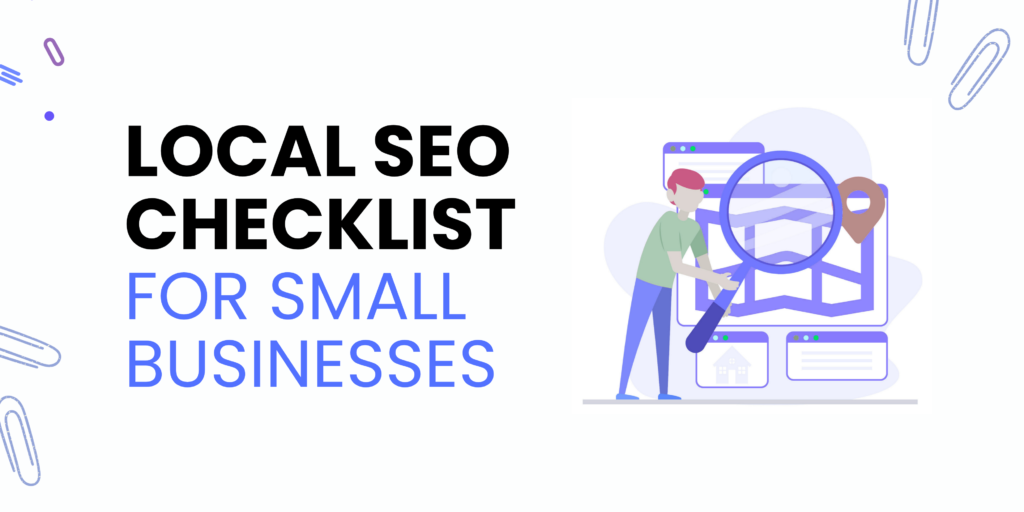
Local SEO means making sure your business shows up when nearby customers search for what you offer. In Google’s Map Pack in search results and increasingly in AI-generated answers. This checklist covers every piece that actually moves the needle, in the order to tackle them, so you’re not guessing where to start, as most small businesses do. Do nothing beyond claiming their Google listing once and forgetting about it, or try to do everything at once and burn out. Work through this list in order. Each section builds on the one before it.
Claim and Fully Optimize Your Google Business Profile
Your Google Business Profile (GBP) is the highest-impact asset in local SEO. It’s what powers your listing in Google Maps and the local “map pack” that appears above organic results for local searches.
- Claim and verify your listing at google.com/business if you haven’t already
- Use your real business name. No keywords stuffed in (“Smith Plumbing Best Plumber Chicago” will get suspended, not ranked)
- Choose your primary category with precision and add relevant secondary categories
- Fill in every field completely: hours, service areas, phone number, website, and a keyword-relevant business description
- Add high-quality photos regularly. Of your location, team, and work. Not just a logo
- List your specific services individually with a short description for each
- Enable messaging and Q&A and actually monitor them
Google increasingly pulls from your GBP content directly for AI-powered local results so treating this as a “set it once” task is one of the most common mistakes small businesses make.
Get Your NAP Consistent Everywhere
NAP stands for Name, Address, Phone number. Inconsistent NAP across the web. Your address is written differently on your website, Yelp, and Facebook. Confuses Google about whether these listings represent the real business, which weakens your local rankings.
- Pick one format for your name, address, and phone number
- Use that exact format on your website, GBP, and every directory or citation
- Audit major directories (Yelp, Bing Places, Apple Maps, industry-specific directories) and fix mismatches
- Update NAP everywhere immediately if you move locations or change your phone number
Build Citations in the Right Directories
A citation is any mention of your business name, address, and phone number. Even without a link. Citations reinforce to Google that your business is real, established, and located where you say it is.
- Start with general directories: Google Business Profile, Bing Places, Yelp, Apple Maps, Facebook
- Add industry-specific directories relevant to your field ( directories for law firms, home-service directories for contractors, etc.)
- Add local/regional directories. Your city’s chamber of commerce, local business associations
- Keep information identical across every listing
Turn Your Website Into a Local Authority
Your Google Business Profile gets you into the map pack, but your website is what convinces both Google and customers that you’re the choice.
- Add your city and service area naturally throughout your homepage and service pages. Not stuffed; just present where it reads naturally
- Create a dedicated page for each location if you serve multiple areas, each with unique content (not the same page copy-pasted with the city name swapped)
- Include your full NAP in your website footer on every page
- Add testimonials that mention specific locations or neighborhoods where relevant
- Make sure your site is mobile-friendly and loads quickly. Most local searches happen on a phone while someone is already nearby
Earn and Manage Reviews
Reviews are one of the strongest local ranking signals, and they’re also the first thing a potential customer checks before calling.
- Ask every customer for a review. Directly right after a good interaction rather than a generic mass email
- Respond to every review, positive and negative, professionally and promptly
- Never buy fake reviews. Google actively detects and penalizes this. It can get your listing suspended
- Monitor review velocity: a steady stream of new reviews over time looks more natural (and performs better) than a burst of 20 reviews in one week followed by silence
Add Local Structured Data (Schema Markup)
Schema markup is code added to your website that explicitly tells search engines what your business is, where it’s located, and what it offers. Rather than making them infer it from your text.
- Add LocalBusiness schema to your homepage, including name, address, phone, hours, and category
- Add Review schema if you display reviews on your site so star ratings can appear directly in search results
- Add FAQ schema to pages that answer common customer questions
- Use Google’s Rich Results Test to confirm your schema is implemented correctly
This is a technical step. Most website platforms and SEO plugins can handle it, or your web developer can add it directly.
Optimize for “Near Me” & Voice/AI Search
The way people search locally keeps shifting. More “near me” phrasing, more voice search, and more AI tools like Google’s AI Overviews summarizing local options directly in the search results.
- Make sure your service pages directly answer specific local questions (“Do you offer emergency plumbing in [city]?”) rather than only general service descriptions
- Keep your GBP description and website content clear and factual. AI tools tend to pull from content that states things plainly rather than in marketing-speak
- Confirm your hours, service areas, and contact details are accurate everywhere since AI-generated answers pull directly from this data
Track What’s Actually Working
- Monitor your Google Business Profile Insights for how customers are finding and interacting with your listing (calls, direction requests, website clicks)
- Track your rankings for your core local keywords over time. A single snapshot won’t tell you much
- Watch for a rise in phone calls and direction requests, not just impressions. Those are the metrics that translate to real business
Common Local SEO Mistakes to Avoid
- Leaving your Google Business Profile unclaimed or incomplete
- Inconsistent NAP across directories
- Copy-pasted location pages with only the city name changed
- Ignoring reviews, especially negative ones
- Treating local SEO as a one-time setup instead of an ongoing effort
Quick Implementation Checklist
- Google Business Profile claimed, verified, and fully completed
- NAP consistent across your website and every directory
- Citations built in major and industry-specific directories
- Website includes local keywords, NAP in the footer, and unique location pages if applicable
- Active review generation and response process in place
- LocalBusiness schema added to your site
- Content answers specific local questions your customers actually ask
- Regular tracking of GBP insights and ranking movement
Frequently Asked Questions
How long does local SEO take to show results?
Many small businesses start seeing meaningful movement in 3-6 months, with GBP optimization often producing the fastest early gains since it doesn’t depend on building website authority.
Do I need a website to rank in the local map pack?
No. The map pack ranks primarily off your Google Business Profile. That said, businesses with a relevant website consistently outperform those without one, especially for searches just outside the map pack.
How many reviews do I need to rank well locally?
There’s no number. What matters more is an ongoing pattern of recent reviews rather than hitting a specific total.
Is local SEO worth it for a service-area business, with no storefront?
Yes. Google Business Profile supports service-area businesses directly. You can hide your address while still defining and ranking in the areas you serve.
Local SEO is a lot to manage on top of running your business. Consult with us, and we’ll show you exactly where your local visibility stands today.